
Discovery
The knowledge you already paid for, finally usable.
Years of decisions, results and hard-won lessons sit buried in inboxes, decks, meeting notes and spreadsheets. We build one living index across everything your teams write, and turn it into context a model can actually reason over.
Runs on your own infrastructure · Your data stays yours · No migration
01 · Remember
Connect your sources where they already live
Mail, decks, transcripts, write-ups and spreadsheets are indexed in place. Nothing gets migrated, and nobody has to adopt another tool to keep their work discoverable.
Examples of source types we index. These are not integrations we resell, and we hold no partner status with these companies.
 Mail
Mail Chat
Chat Docs
Docs Wiki
Wiki Drive
Drive Object store
 Tickets
02 · Refine
Local agents, working while you sleep
A resident swarm pulls results out of raw material, reconciles the vocabulary each team invented for itself, stitches related threads of work together, and re-indexes the moment new files land.
Building your knowledge, continuously
03 · Retrieve
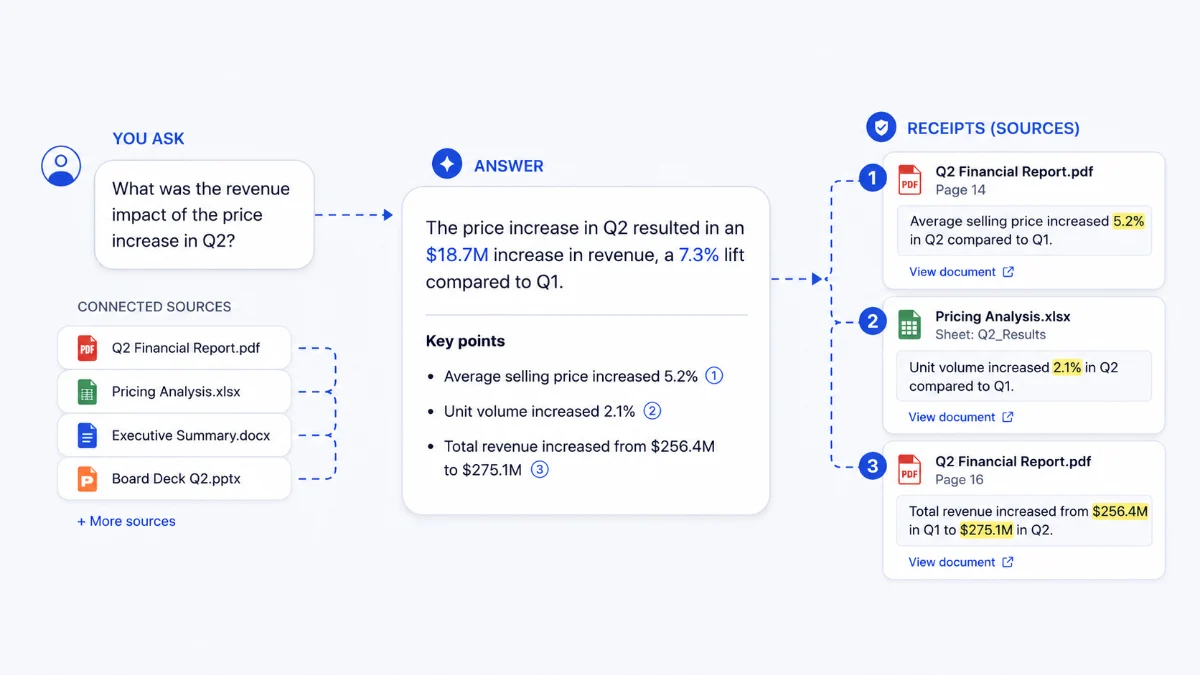
Ask in plain language, get answers with receipts
Search or chat across every connected source. Every claim comes back linked to the document it came from, so a reviewer can check the work instead of trusting it. No black box, no invented citations.
A reviewer can open any figure in one click and land on the page it was drawn from, with the sentence highlighted. If a claim has no source, it does not get made.
04 · Discover
Point whichever model you use at it
Frontier or self-hosted, the model stops guessing from general knowledge and starts reasoning over what your organisation has actually tried, including the attempts that failed, then proposes what to run next.
Nothing leaves your boundary to make this work. The index runs where your data already sits, and the model reads it under your access rules.
What Discovery will not do
Knowing where a system stops is part of knowing whether to trust it. These are the limits we would rather you hear from us than discover in month three.
Invent what nobody wrote down
If a decision was made in a corridor and never recorded anywhere, no index can recover it. Discovery finds what exists. It will tell you when the record is thin rather than filling the gap with a plausible answer.
Settle a disagreement for you
It can show you that two teams reached opposite conclusions, and what each of them was looking at. Deciding which one holds now is still a human judgement, and it should be.
Replace the person who knows
The point is not to make your experts unnecessary. It is to stop the same question reaching them for the fifth time, so the questions that do reach them are the ones worth their attention.
Move your data somewhere new
Nothing is migrated, copied to our infrastructure, or used to train a model we ship to anyone else. If that ever needs to change for a feature to work, we will ask first and you can say no.
The thirty day pilot
One dataset, one month, and a straight answer about what you already know.
Pick the messiest corner of your knowledge. We index it in place, score what comes back against questions your own people ask, and hand you the results either way.
Fixed scope · no infrastructure changes · you keep the index
Connect one source, in place
Read access to a single system. Nothing is migrated and nothing leaves your environment.
Index, reconcile, and score
Agents extract results and normalise vocabulary while we build an evaluation set from questions your teams actually ask.
Readout with numbers
Pass rate on that question set, the gaps we found, the expertise nobody knew was there, and whether a wider rollout is worth it.